
Virtual Reality Impacts on The Immersion of Reading

Virtual reality (VR), as an emerging platform of visual display, provides a totally different reading experience and reading paradigm. VR devices allow users to read through a 3D panoramic display which creates a strong immersion as if the user were surrounded by some specific environment. However, it is still unknown whether virtual reality reading provides better reading effects comparing with traditional reading platforms. In order to further investigated the correlation between display format and reading comprehension, this study looked to explore the difference between virtual reality reading and traditional reading mainly focusing on the process efficacy and reading behavior.
This study investigates the following research questions:
RQ1. Do users experience higher levels of flow experience in VR reading mobile reading or books?
RQ2. Which reading format provides the highest reading efficacy?
RQ3. What characteristic of reading behavior in VR reading can be found?
The present research used a two-factor design, with a type of text as a within-subjects factor and media presentation (paper, Kindle, and VR) as a between-subjects factor. The primary dependent variable was the efficacy for the reading comprehension.
How Interactivity Impacts User Behavior and User Experience

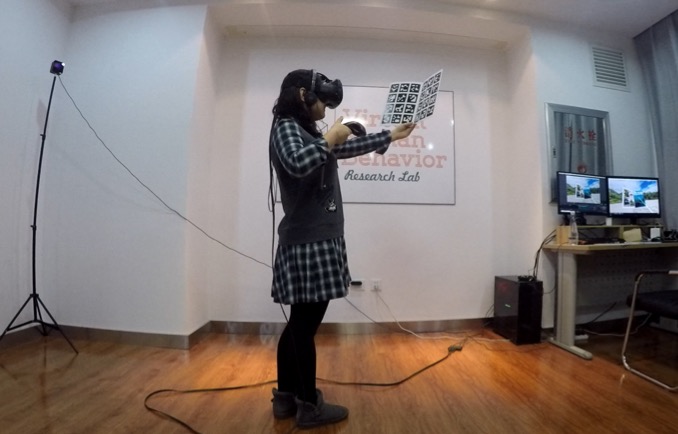
Virtual reality (VR) tracking systems and interaction designs have been widely developed and applied in industries and disciplines. However, only empirical studies could answer the most important questions about user’s engagement, enjoyment and learning outcomes. This study investigates whether the way the user interacts in a virtual environment impacts user behavior and user experience. We conducted a comparative experiment based on a VR reading application which provides three different ways of user interaction in a virtual environment: 1) interaction with motion controllers only; 2) interaction with the motion controller and VR Book ; 3) interaction with VR Book only. 30 Participants were divided into three groups and each group finished reading tasks in a VR environment with one of the three ways of interaction. Participants’ first-person view was screen recorded and participants’ behavior were video recorded. After the experiment, the sense of presence and reading efficacy was measured by a comprehensive questionnaire. The poster demonstrates the process of the experiment and the results of data analysis.

Augmented Reality in Situational Teaching

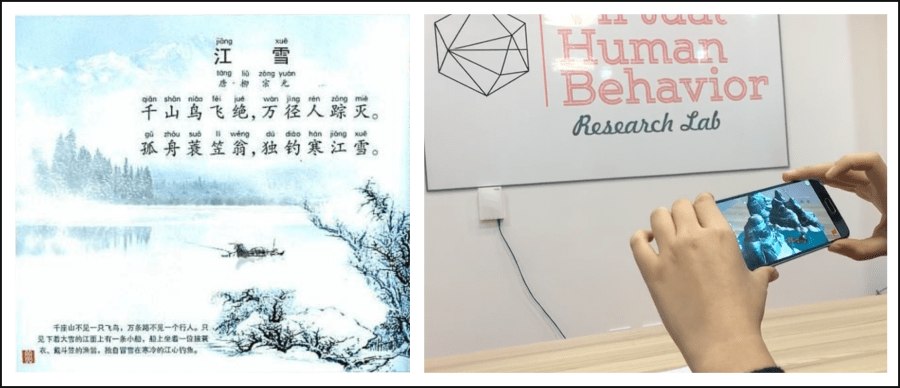
In this study, we designed an augmented reality application for Chinese ancient poetry teaching. The application designed in this paper presents a scene depicted of the ancient poem Jiangxue, accompanied by music and recitation sound. In addition, when students touch a specific object on the screen, the character will interact accordingly. Based on this application, this study investigates whether augmented reality learning can improve students’ learning effect and what factors of immersion affect the learning outcome in a mixed experimental way.

The core of situational teaching is to arouse students’ emotion which is widely applicable to ancient poetry teaching. The traditional teaching method of ancient poetry often disintegrates the poems, making it difficult for students to apprehend the reason or be touched by the scene depicted. Chinese ancient poetry teaching should pay more attention to the understanding of image and artistic conception as well as the aesthetic cultivation. Jiangxue, using many images to construct artistic conception, is a classical teaching case for primary poetry teaching and aesthetic cultivation. Taking Jiangxue as a case study, it can well teach students to comprehend the emotional color attached to and experience multiple images in the form of overall artistic conception.